
 By admin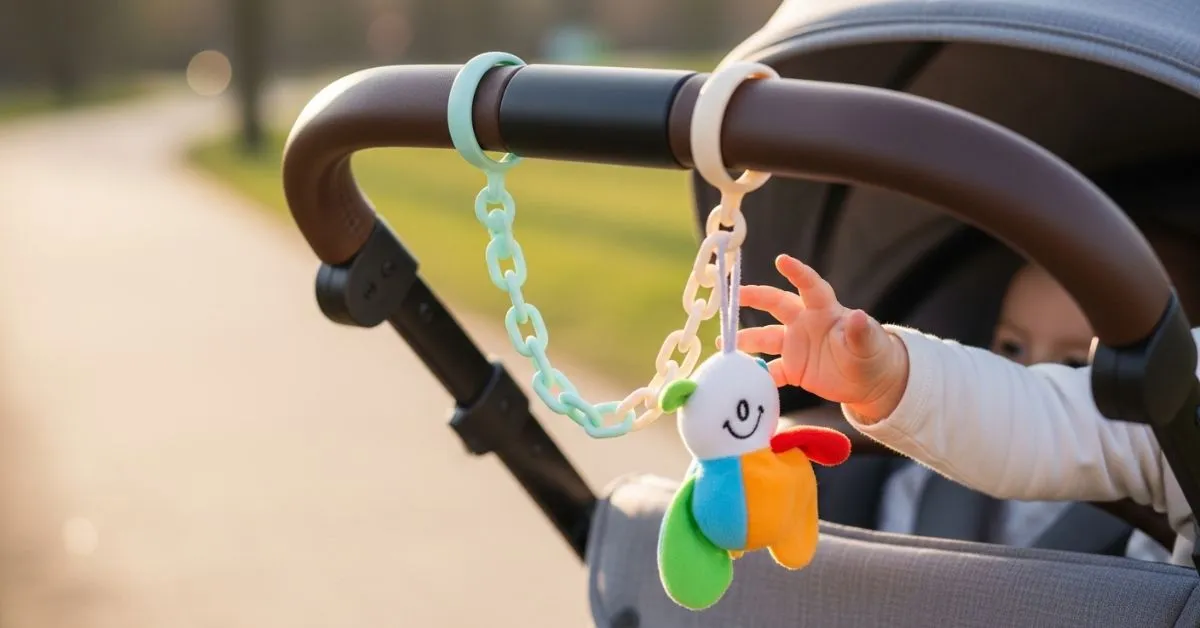
A pram chain sounds like the simplest thing in the world — until your toddler flings their favourite toy off a moving stroller for the eighth time in one afternoon. Here’s everything you actually need to know about Crocolini and whether it solves the problem for good.
It happened on a rainy Tuesday in a supermarket car park. My friend Sarah was loading groceries with one hand, steering her Silver Cross pram with the other, and somewhere between the trolley bay and the boot, her daughter’s beloved stuffed elephant vanished. Not kidnapped. Not magically transported. Just bounced off the footrest, landed face-down in a puddle, and got run over by the next trolley. The toy was ruined. The toddler was inconsolable for three days.
That story plays out in some version in almost every household with a pram-age child. The toy-drop problem is so universal it borders on comic — except when you’re the parent living it at 7 a.m. on the school run. That’s exactly why pram chains exist, and it’s why Crocolini has quietly built a loyal following among parents who’ve discovered that not all pram chains are made the same.
This guide covers everything: what makes a Crocolini pram chain stand out, how to choose the right one, safety considerations nobody talks about honestly, real-world durability, and honest answers to the questions that keep coming up in parenting forums.
A pram chain — sometimes called a stroller toy clip, dummy chain, or pram strap — is a short, flexible connector that attaches one end to the pram frame or bumper bar and the other end to a toy, dummy, teething ring, or similar item. The idea is straightforward: the item can’t fall to the ground because it’s tethered.
What’s less obvious is how much variation there is in quality, safety, and design. A cheap chain from a supermarket checkout might have clips that snap open under mild tension, clasps that can be mouthed or chewed loose, or links long enough to pose a ligature hazard. The Crocolini range sits at the more considered end of the market, and for good reason — the brand started from a parent-led place, not a factory catalogue.
The name itself is a small clue. “Crocolini” leans playful and tactile, which matches the product philosophy: these are accessories designed to be held, chewed, pulled, and dragged by small children, so every material and construction choice matters.
Here’s what nobody tells you when you’re standing in a baby shop comparing pram chains on a Tuesday afternoon: most of what you’re looking at is functionally identical, made from the same handful of factories in the same materials, differing mainly in the colour of the silicone and the font on the packaging.
Crocolini breaks from that pattern in a few meaningful ways.
Crocolini chains are made from food-grade silicone, which matters enormously in this product category. Babies mouth everything. A chain that spends hours pressed against a child’s face, wrapped around their fist, or occasionally in their mouth should not be leaching plasticisers or phthalates. Food-grade silicone is tested to a higher standard than general-purpose plastic, and it holds up to repeated sterilisation — boiling, steam sterilising, or cold water sterilising — without degrading.
Cheaper alternatives often use BPA-free plastic as a selling point, which is meaningful but not the same benchmark. BPA-free simply means one specific compound is absent; it says nothing about dozens of other potentially problematic plasticisers. Food-grade silicone addresses a broader safety profile.
The clips on a pram chain need to satisfy two competing requirements: strong enough that a tugging toddler can’t accidentally detach a toy (and potentially create a small choking-hazard piece), and easy enough for a tired parent to operate one-handed while steering a pram.
Crocolini uses a clip mechanism designed with deliberate resistance — it requires a specific two-step motion to release that a young child is unlikely to replicate by accident, while remaining manageable for adults. This is the kind of engineering detail that sounds minor until you’ve watched a determined two-year-old systematically work open a standard clip over the course of a ten-minute car journey.
This is the safety point that deserves more attention than it typically gets. The UK’s Lullaby Trust and similar infant safety organisations internationally recommend that any cord, strap, or chain near a young child should be short enough that it cannot loop around the neck. For pram accessories, this means chains should generally be under 22 centimetres when fully extended. Crocolini chains fall within safe parameters on this measure. Many budget alternatives don’t, and the packaging rarely flags it.
| Brand / Type | Material | Clip type | Length | Price range | Sterilisable? |
| Crocolini | Food-grade silicone | Safety double-release | ~18–20 cm | Mid range | Yes |
| Mushie dummy clip | Food-grade silicone | Single clip | ~20 cm | Mid range | Yes |
| Generic supermarket chain | BPA-free plastic / nylon | Single spring clip | 22–30 cm (varies) | Budget | Wipe only |
| BIBS clip | Natural rubber / silicone | Button loop | ~22 cm | Mid range | Yes |
| Itzy Ritzy stroller strap | Vegan leather / metal | Swivel clasp | ~30 cm | Mid–premium | Wipe only |
The table above deliberately includes a range of price points and materials. What jumps out is that length and sterilisability are where budget options most often compromise. If you’re primarily attaching a dummy or teething toy — items that go directly into a baby’s mouth — the inability to fully sterilise a chain is a real limitation, not just a minor inconvenience.

I asked several parents in a UK-based baby gear community about their experience with Crocolini chains after extended use. The responses were more nuanced than the five-star reviews on retail sites tend to suggest.
One parent with an eight-month-old reported that the chain had been through the washing machine accidentally twice (not recommended, but it happens) with no visible damage to the silicone or clips. Another noted that the colour pigmentation held better than a competitor’s chain she’d had for the same period, which had started to look cloudy and faded after repeated sterilising.
The one consistent complaint — and it’s a minor one — was around the clip attachment to certain pram frames. Thicker bumper bars on premium prams like the iCandy Peach or Uppababy Vista sometimes required a bit of finessing to clip onto securely. This isn’t unique to Crocolini; it’s an industry-wide fit issue that hasn’t been fully solved. The workaround most parents used was a short fabric loop or karabiner attachment point on the pram, which the chain then clips onto cleanly.
Practical tip
If you have a pram with an oversized bumper bar, attach a small fabric tag or carabiner to the bar first. Most pram accessories attach more reliably to a secondary attachment point than directly to a thick bar.
Crocolini makes more than one version, and the differences matter depending on how you plan to use it.
If the primary use is keeping a dummy from falling to the ground, prioritise a chain with a fabric or loop end (not a second clip) that can thread through a dummy ring. A second clip end is less secure for dummies and can create pressure points on delicate baby skin if the chain gets turned around during sleep.
For attaching soft toys, rattles, or pram activity toys, you want a clip on both ends with enough give in the chain that the toy hangs naturally and doesn’t pull awkwardly on the pram frame. The Crocolini options with slightly longer extension (around 20 cm) work better here than the shorter dummy-specific versions.
Newborns need shorter chains with simpler attachment — they’re not actively grabbing and pulling. By the time a child is 12 to 18 months, they’re testing every attachment mechanism within reach. This is the age when clip strength and release complexity matter most, and where Crocolini’s design holds up better than simpler alternatives.
- Total length under 22 cm when fully extended (measure it yourself, don’t trust packaging)
- No small parts that can detach under sustained pulling force
- Clip requires deliberate adult motion to open — not just pressure or a single pinch
- Material safe for mouthing: food-grade silicone or natural rubber preferred
- No sharp edges or metal components that can corrode
- Replace any chain that shows cracking, discolouration, or clip stiffness
That last point is underrated. Parents often keep pram accessories long past their practical lifespan. Silicone does degrade over time, especially with repeated heat sterilising. If a chain is more than 18 months old and has been sterilised regularly, it’s worth replacing regardless of how it looks on the surface.
Are Crocolini pram chains safe for newborns?
Yes, but with caveats. The chain should never be used in or near a sleep space, and should only be attached to the pram when a caregiver is present. For newborns specifically, check that the chain’s resting length keeps any attached item well away from the face. Most Crocolini chains are designed with this in mind, but always verify the length for your specific pram and seating position.
Can I use a Crocolini chain to attach a dummy at night?
No. Dummy chains and pram chains should never be used in cots, cribs, or any sleep environment. This is a firm safety recommendation from all major infant sleep organisations. Pram chains are for supervised pram use only.
How do I clean a Crocolini pram chain?
Food-grade silicone chains can be sterilised by boiling for five minutes, cold water sterilising solution, or a steam steriliser. Avoid microwave sterilisers unless the manufacturer specifically confirms compatibility. After sterilising, air dry rather than towel dry to avoid lint transfer.
What’s the difference between a pram chain and a dummy clip?
In practice, the terms are used interchangeably, but there’s a subtle distinction. A dummy clip typically has one end designed for dummy attachment (a loop or fabric tab) and one clip for the clothing or pram. A pram chain often has clips on both ends, making it better suited for attaching toys to the pram frame. Some products work as both.
My toddler keeps pulling the chain off the pram. What can I do?
This is a rite of passage. The first option is to try attaching to a less accessible point on the pram — further back on the frame, or through a fabric loop rather than directly clipping. The second option is to accept that some children are simply more determined than any clip design can accommodate, and switch to attaching toys via the pram’s own tether points if available.
Are all Crocolini chains the same, or are there different versions?
Crocolini produces several versions with variations in colour, length, and clip configuration. The core material and safety standards are consistent across the range. Colour availability changes seasonally, which is worth knowing if you’re trying to match a specific pram aesthetic — a popular colourway can sell out and not return for months.
Pram chains sit in an interesting corner of the baby gear market. They’re cheap enough that most parents buy them without much research, and yet they spend hours every week in direct contact with a baby — being mouthed, grabbed, pressed against skin, and generally subjected to everything a curious infant can throw at them.
The tendency to underinvest in small accessories while spending thousands on the pram itself is one of those parenting quirks that makes logical sense (the pram is the big-ticket item) but gets the risk calculus slightly wrong. A poor-quality chain attached to the pram your baby spends their first year in is worth thinking about as carefully as the pram itself.
Crocolini doesn’t solve every problem in this space. No single product does. But it addresses the main ones — material safety, clip reliability, appropriate length — with more care than the budget alternatives. For most parents, that’s the right trade-off.
The toy-drop problem will still happen. Your child will still be outraged when their elephant is momentarily out of reach. But at least it’ll be swinging from the bumper bar rather than face-down in a puddle in a supermarket car park.
What’s your experience been with pram accessories — have you found a chain that genuinely holds up, or is this still an unsolved problem in your household? The forum discussions on this topic are surprisingly passionate, and there may be solutions worth sharing that haven’t made it into the mainstream yet.