
 By Callum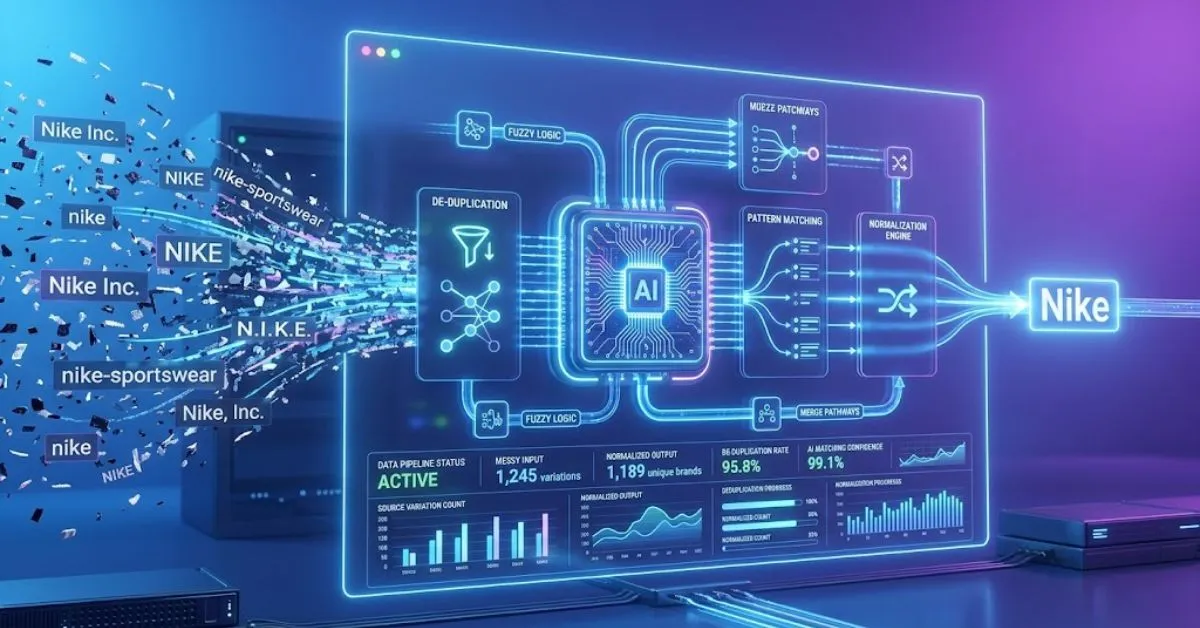
- Brand name normalization rules standardize inconsistent company names into one clean format.
- Common rules include case standardization, removing legal suffixes, and handling abbreviations.
- Tools like Python, Pandas, and OpenRefine make automation easy.
- Poor brand data leads to duplicate records, broken reports, and lost revenue.
- A clear normalization ruleset improves data quality, deduplication, and CRM accuracy.
Picture this: your CRM has “Nike Inc.”, “NIKE”, “nike”, and “Nike, Inc.” all listed as separate companies. Your sales team is confused. Your reports are wrong. And nobody knows which record is the real one.
That’s what messy brand data looks like. And it happens more often than you’d think.
Brand name normalization rules are the fix. This guide breaks down exactly what they are, why they matter, and how to actually implement them in your data pipelines. Whether you’re cleaning CRM data, building a product database, or running analytics, this is the guide you need.
Brand name normalization rules are a set of standardization guidelines used to clean and unify inconsistent brand or company name data. They ensure that variations like “Apple Inc.”, “APPLE”, and “Apple Computer” are recognized as the same entity. Normalization improves data accuracy, removes duplicates, and makes analytics more reliable across CRM systems, databases, and data pipelines.
Let’s be honest. Most data teams underestimate this problem until it blows up.
You merge two CRMs after an acquisition and suddenly you have 4,000 duplicate company records. Or you run a revenue report and “McDonald’s” shows up in six different spellings, each with its own revenue number. None of them match.
This is not just an annoyance. It has real business consequences.
- Duplicate accounts in your CRM pollute pipeline data
- Analytics dashboards show wrong numbers
- Marketing emails get sent twice to the same company
- Sales reps work the same prospect without knowing it
- Data integrations break when source systems disagree on naming
Here’s the thing: the root cause is almost always the same. Data comes from multiple sources, entered by different people, in different formats, at different times. Nobody set rules upfront. Now you’re dealing with the mess.
Brand data standardization isn’t glamorous work. But fixing it saves hours of manual cleanup every single week.
Before diving into the rules themselves, it helps to understand a few core ideas.
Entity Resolution This is the process of figuring out when two records refer to the same real-world entity. “McDonald’s Corp” and “McDonalds” are the same company. Entity resolution is what makes that connection.
Data Deduplication Once you know two records refer to the same entity, deduplication merges them into one clean record. Normalization is what makes deduplication possible.
Canonical Form This is the “official” version of a name that all variations map to. For example, the canonical form for “nike inc.” and “NIKE” might be “Nike”. Every variation collapses into one agreed-upon format.
Fuzzy Matching Not all duplicates are exact. “McDonald’s” and “McDonalds” differ by one character. Fuzzy matching algorithms (like Levenshtein distance) find these near-matches. Normalization first makes fuzzy matching far more accurate.
Data Preprocessing Normalization is one step in a broader data preprocessing pipeline. You clean, normalize, deduplicate, enrich, and validate. Skipping normalization breaks every step that comes after.
These are the actual rules you apply, in order of priority.
The simplest rule. Pick one case format and stick to it.
Options:
- Title Case (recommended): “Nike”, “Apple”, “McDonald’s”
- Uppercase: “NIKE”, “APPLE”
- Lowercase: useful for internal matching before display
In real-world data, you’ll see all three. Standardize to Title Case for display and lowercase for matching logic.
import pandas as pd
df[‘brand_name’] = df[‘brand_name’].str.strip().str.title()
“Apple Inc.”, “Apple LLC”, “Apple Corp”, “Apple Ltd.” These are all Apple. The legal suffix tells you the business structure, not the brand.
Strip them during normalization unless the suffix is genuinely meaningful for your use case.
Common suffixes to remove:
| Suffix | Variations |
| Incorporated | Inc, Inc., Incorporated |
| Limited | Ltd, Ltd., Limited |
| Corporation | Corp, Corp., Corporation |
| Company | Co, Co., Company |
| Limited Liability Company | LLC, L.L.C. |
| Public Limited Company | PLC, P.L.C. |
import re
suffixes = r’\b(Inc\.?|LLC|Ltd\.?|Corp\.?|Co\.?|PLC|Limited|Incorporated|Corporation)\b’
df[‘brand_clean’] = df[‘brand_name’].str.replace(suffixes, ”, flags=re.IGNORECASE).str.strip()
Punctuation causes more matching failures than almost anything else. “McDonald’s” vs “McDonalds” vs “Mc Donald’s” are three different strings to a database, even though they’re the same brand.
Rules here:
- Remove trailing periods and commas
- Standardize apostrophes (smart quotes vs straight quotes)
- Remove extra spaces and tabs
- Handle hyphens consistently (keep or remove, just be consistent)
df[‘brand_clean’] = df[‘brand_clean’].str.replace(r”[^\w\s\-\’]”, ”, regex=True)
df[‘brand_clean’] = df[‘brand_clean’].str.replace(r’\s+’, ‘ ‘, regex=True).str.strip()
Some brands genuinely go by multiple names. “3M” is also “Minnesota Mining and Manufacturing.” “GE” is “General Electric.” “HP” is “HP Inc.” or “Hewlett-Packard” depending on the era.
For these, you need a variation mapping table: a lookup dictionary that maps known aliases to a canonical form.
brand_mapping = {
“3m”: “3M”,
“minnesota mining”: “3M”,
“ge”: “General Electric”,
“general electric co”: “General Electric”,
“hp”: “HP Inc.”,
“hewlett packard”: “HP Inc.”,
“mcdonalds”: “McDonald’s”,
“mcdonald’s”: “McDonald’s”
}
df[‘brand_canonical’] = df[‘brand_clean’].str.lower().map(brand_mapping).fillna(df[‘brand_clean’])
“IBM” stays “IBM” because that’s the official brand name. But “Intl. Business Machines” should map to “IBM.”
The rule: if the abbreviation IS the brand (Nike, IBM, HP), keep the abbreviation. If the abbreviation is informal shorthand, expand it to the canonical form.
Build a dedicated abbreviation dictionary for your industry or dataset.
The gold standard. Maintain a master brand registry, a single source of truth with one canonical name per company. Every incoming record gets matched against this list.
This is especially important in B2B data, product catalogs, and CRM systems. Tools like OpenRefine’s clustering feature or a custom fuzzy matching pipeline make this scalable.
Okay, so how do you actually do this? Here’s a practical workflow.
Step 1: Audit your existing data Pull all unique brand/company names from your dataset. Look for obvious duplicates, misspellings, and formatting inconsistencies. A quick value_counts() in Pandas is a good starting point.
Step 2: Define your canonical form Decide what “clean” looks like. Title Case? No legal suffixes? No punctuation? Write it down. Seriously, document this before you write a single line of code.
Step 3: Apply rule-based cleaning Apply your normalization rules in a consistent order: strip whitespace, standardize case, remove suffixes, clean punctuation, expand abbreviations.
Step 4: Build your variation mapping table Manually review what’s left after rule-based cleaning. Create a lookup table for known aliases, abbreviations, and brand variations.
Step 5: Run fuzzy matching for remaining duplicates Use libraries like fuzzywuzzy or rapidfuzz in Python to catch near-duplicates that rule-based cleaning missed.
from rapidfuzz import process, fuzz
def find_best_match(name, choices, threshold=85):
match = process.extractOne(name, choices, scorer=fuzz.token_sort_ratio)
if match and match[1] >= threshold:
return match[0]
return name
Step 6: Validate and review Never fully automate without a review step. Sample 200-300 records after normalization and manually check. Catch false positives before they corrupt your data.
Step 7: Automate and monitor Once the rules are solid, automate them in your data pipeline. Set up alerts for new brand names that don’t match your master list, so they get reviewed and added.
In real-world data, it’s never as clean as the examples suggest. Here are the issues teams run into most often.
Same name, different company “Delta” could be Delta Air Lines or Delta Dental or Delta Faucet. Context matters. Domain, industry, or country fields help disambiguate. This is where entity resolution gets genuinely hard.
International brand names “Volkswagen” vs “VW” vs “Volkswagen AG” vs the German-language variant. International datasets bring non-ASCII characters, different naming conventions, and localized brand names.
Brand name changes over time “Facebook” became “Meta.” “Google” is now technically “Alphabet.” Historical data may use old names. Decide whether to backfill old names with new canonical forms.
Acquired brands Instagram is owned by Meta but trades under its own name. Do you normalize to the parent company or keep the brand identity? The answer depends on what question you’re trying to answer.
Inconsistent data entry When humans type brand names manually into a CRM, chaos follows. Typos, autocorrects, abbreviations, department names, product names entered as company names. No normalization rule handles everything.
Some of these are painful lessons learned the hard way.
Over-normalizing Stripping too aggressively causes false merges. “Amazon” (the company) and “Amazon” (the river in a description field) are not the same. Apply normalization only to fields designated for brand/company names.
Skipping documentation If you don’t document your normalization rules, nobody can maintain them. Six months later, a new team member will add conflicting rules and break everything quietly.
Not handling NULL values Empty or null brand name fields will break string operations. Always handle nulls before applying normalization logic.
df[‘brand_name’] = df[‘brand_name’].fillna(”).str.strip()
Normalizing once and forgetting New data comes in every day. If you normalize once and don’t enforce rules on incoming records, the mess rebuilds itself. Normalization needs to be baked into your ingestion pipeline.
Ignoring edge cases “The Coca-Cola Company” vs “Coca-Cola” vs “Coke.” The brand is Coca-Cola. But your rules might strip “The” and result in “Coca-Cola Company” matching “Cola Company” via fuzzy matching. Edge cases matter.
You don’t have to build everything from scratch. Here are the tools that work well for company name normalization.
| Tool | Best For |
| Python + Pandas | Rule-based cleaning pipelines |
| RapidFuzz | Fast fuzzy string matching in Python |
| OpenRefine | Manual clustering and exploratory cleaning |
| dbt | Normalization rules inside SQL data pipelines |
| Dedupe.io | ML-based deduplication for large datasets |
| Apache Spark | Large-scale normalization across big data |
| Clearbit / ZoomInfo | Enrichment and canonical brand name lookup |
For most teams starting out, Python plus Pandas plus RapidFuzz covers 90% of use cases. OpenRefine is excellent for exploratory cleanup on smaller datasets where you want a visual interface.
Keep these in mind as you build your normalization process.
- Normalize at ingestion, not after the fact. It’s 10x easier to catch issues at entry than to clean millions of records later.
- Maintain a living master brand registry that gets updated when new brands appear.
- Use a staging environment to test normalization rules before they hit production data.
- Keep the original raw value in a separate column. Never overwrite source data. You may need to audit later.
- Versioning your normalization rules matters. Use Git or a config file so you can track what changed and when.
- Involve data consumers (sales, marketing, analysts) in defining canonical names. They know what “correct” looks like for their use case.
Example 1: Cleaning a B2B CRM A SaaS company merged two sales CRMs after an acquisition. They found “Apple Inc.”, “Apple”, “APPLE INC”, “Apple Computer”, and “Apple Computers” all as separate accounts. After applying normalization rules and fuzzy matching, all five collapsed into one canonical record: “Apple.” Their duplicate rate dropped from 18% to under 2%.
Example 2: E-commerce Product Catalog A retail aggregator pulled product data from 40 suppliers. “Nike”, “NIKE Inc.”, “Nike, Inc.”, and “Nike Sports” all appeared as separate manufacturer entries. A simple suffix-removal and case-normalization script reduced 847 brand entries to 612 clean, deduplicated brands.
Example 3: Marketing Analytics A marketing agency was reporting ROI by brand for a large client. “McDonald’s” appeared as 9 different strings across campaign data, CRM records, and ad platform exports. Spend was split across all nine. After normalization, consolidated reporting showed the true ROI for McDonald’s as a single brand, and the numbers finally told a coherent story.
When done right, the payoff is significant.
- Better data quality. Clean brand data means every downstream report, model, and integration is working with accurate information.
- Fewer duplicate records. Deduplication only works well when names are normalized first.
- Reliable CRM data. Sales and marketing teams trust the data more and waste less time reconciling records manually.
- Faster analytics. Analysts spend less time cleaning data and more time actually analyzing it.
- Improved machine learning. Models trained on normalized data perform better because the signal is cleaner.
- Stronger integrations. Systems that exchange data stay in sync when they agree on canonical brand names.
What are brand name normalization rules?
They are standardization guidelines that convert inconsistent brand name variations into one clean, consistent format for accurate data matching and analysis.
Why do brand names need normalization?
Because data comes from multiple sources and gets entered inconsistently. Normalization ensures “Nike Inc.” and “NIKE” are treated as the same entity.
What is the best tool for brand name normalization?
Python with Pandas and RapidFuzz is the most flexible option. OpenRefine works well for smaller datasets needing manual review.
How do I handle brand name abbreviations?
Build a lookup dictionary mapping abbreviations to their canonical forms. Apply it after initial rule-based cleaning.
What is the difference between normalization and deduplication?
Normalization standardizes name formats. Deduplication merges duplicate records. Normalization comes first and makes deduplication far more effective.
How often should brand data be re-normalized?
Normalization should run on every new data ingestion. Quarterly audits of the master brand list are also recommended.
Can AI help with brand name normalization?
Yes. LLMs and ML-based tools can identify fuzzy matches and suggest canonical names, especially for large, messy datasets with many edge cases.
Brand name normalization rules are not exciting. Nobody is going to stand up at a company all-hands and celebrate a clean brand registry. But messy brand data quietly causes bad decisions, broken reports, and wasted sales effort every single day.
Start simple. Pick a canonical format. Remove legal suffixes. Standardize case. Build a variation mapping table. Automate it in your pipeline.
Do that, and you’ll have cleaner data than 80% of companies your size. That’s not an exaggeration.
The teams that take data quality seriously are the teams that can actually trust their analytics. And that trust is worth more than any dashboard feature or new tool you could add.
Clean your brand data. Your future self will thank you.