
 By admin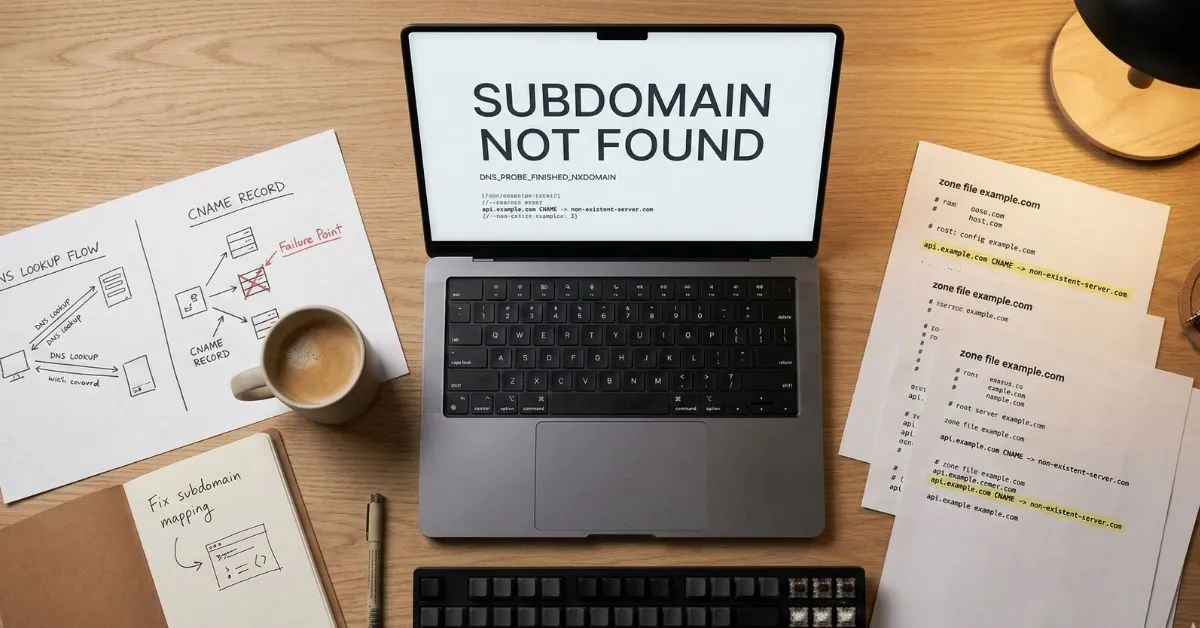
When you see “keine karriere-subdomain gefunden”, it means a career subdomain — such as karriere.example.com — was expected but could not be located. This is a configuration error, not a security threat and not a problem with your internet connection. It affects both job seekers who cannot access open positions and businesses that silently lose applicants every day it goes unfixed. This guide explains exactly what it means, why it happens, and how to resolve it step by step.
“Keine karriere-subdomain gefunden” (German: “no career subdomain found”) is a system message indicating that a website’s career subdomain — typically karriere., jobs., or careers. — is missing, misconfigured, or unreachable. It is a DNS or hosting configuration issue, not a browser error or user mistake.
- What it means: The career subdomain your browser or recruiting system tried to reach does not exist or is not responding.
- Who it affects: Job seekers who cannot apply, HR teams losing candidates, and businesses suffering silent SEO damage.
- Primary causes: DNS misconfiguration, website migration, expired hosting, or a subdomain that was never created.
- Is it dangerous? Not to your device. But it is damaging to your company’s recruitment pipeline and search visibility.
- How fast can it be fixed? DNS fixes typically propagate within 15 minutes to 48 hours. Hosting issues can be resolved in minutes.
- Can Google still index jobs without the subdomain? No. Missing subdomains prevent Google for Jobs from indexing your listings.
- Prevention: Uptime monitoring, pre-migration checklists, and cross-team coordination eliminate this error entirely.
The phrase is German and translates directly to “no career subdomain found.” It is generated by a web platform, CMS, or custom backend when a request reaches a server that expected a career-specific subdomain to be active — but it isn’t.
This is different from a standard 404 error. A 404 means a page was not found on an existing domain. This message means the subdomain itself — the entire karriere.example.com namespace — either doesn’t exist in DNS, isn’t pointed at a server, or isn’t configured in the hosting environment.
Job seekers who click a “Careers” link on a company website and land on this message instead of job listings. They typically abandon the site and apply elsewhere.
Website owners and developers who see this after a site migration, platform switch, or DNS change and need to diagnose and restore the subdomain quickly.
Understanding the error requires understanding subdomain architecture.
A subdomain is a prefix added to a root domain. For karriere.example.com:
- example.com is the root domain
- karriere is the subdomain
- The subdomain requires its own DNS record (an A record or CNAME) pointing to a server or IP address
- The server must be configured to accept requests for that subdomain
- The hosting environment or CMS must have the subdomain mapped to the correct application or directory
If any one of these three layers fails, the result is “keine karriere-subdomain gefunden.”
| Factor | Subdomain (karriere.example.com) | Subfolder (example.com/karriere) |
| SEO treatment | Treated as separate entity by Google | Inherits main domain authority |
| Setup complexity | Requires DNS + hosting config | Simple, no DNS needed |
| Error risk | Higher (DNS/hosting can fail independently) | Lower |
| Google for Jobs | Works well with both | Works well with both |
| Branding | Clean, professional | Acceptable |
| Recommended for | Large enterprises with dedicated HR platforms | SMEs and simpler setups |
For most small and mid-sized companies, a subfolder (/karriere/) carries less technical risk and inherits domain authority more directly. Subdomains are better suited for companies using dedicated ATS (Applicant Tracking System) platforms like Workday, Greenhouse, or SAP SuccessFactors that require their own hosting environment.
Some companies link to karriere.example.com in their navigation or job ads without ever creating the DNS record. This is especially common after rebrands, when old subdomains are referenced in cached content.
The most frequent technical cause. If the A record or CNAME for karriere is deleted, misconfigured, or points to the wrong IP address, the subdomain becomes unreachable instantly.
When migrating from one hosting provider or CMS to another, developers often move the main domain but forget to recreate subdomain DNS records and hosting configurations. This is the single most preventable cause.
Some shared hosting plans limit the number of subdomains or require manual activation per subdomain. A newly created DNS record means nothing if the hosting environment isn’t listening for that subdomain.
If a company has an SSL certificate for example.com but not for karriere.example.com, browsers will refuse to load the subdomain and display a security error — which some platforms render as a subdomain-not-found message.
Companies using third-party ATS platforms (Greenhouse, Lever, Workday, Personio) often set up a CNAME record pointing to the ATS provider’s servers. If the ATS account is cancelled, the plan is downgraded, or the CNAME target changes on the provider’s end, the subdomain stops resolving.
Platforms like WordPress with multisite, Typo3, or custom CMS setups sometimes require explicit subdomain registration within the CMS itself. A valid DNS record alone is not enough — the CMS must also be configured to serve content at that subdomain.
From a candidate’s perspective, landing on this error creates immediate friction:
Loss of trust: A broken career page signals that the company is disorganized or that the job posting may be outdated.
Application abandonment: Most candidates will not call or email to ask for the correct URL. They move on to the next opportunity.
Negative employer brand impression: In a competitive hiring market, first impressions matter. A missing career page is a first impression that communicates neglect.
Confusion about job availability: Candidates who found the company through a job board may not be able to verify whether the position is still open.
The damage to the business side is measurable and ongoing.
Silent applicant loss: Unlike a server crash, a broken subdomain doesn’t trigger alerts in most analytics setups. Companies can lose weeks or months of applicant traffic without noticing.
Google for Jobs delisting: Google’s job search feature requires structured data (JobPosting schema) served from accessible URLs. If the career subdomain is down, Google cannot crawl job listings, and they are removed from Google for Jobs results — eliminating a major free traffic source.
Reduced crawl budget allocation: Search engines reduce crawl frequency for domains with persistent errors. A broken subdomain can depress overall domain health scores.
Employer brand damage: Review platforms like Kununu and Glassdoor often link directly to company career pages. Broken links from these high-authority sites signal neglect to both candidates and search engines.
Increased HR workload: Candidates who can’t find the career page contact HR directly via LinkedIn, email, or phone — creating unnecessary manual work.
Before fixing anything, confirm exactly what is broken.
Step 1 — Check DNS resolution: Use a tool like nslookup (Windows) or dig (macOS/Linux):
nslookup karriere.example.com
dig karriere.example.com
If the result is NXDOMAIN (non-existent domain) or no IP address is returned, the DNS record is missing or wrong.
Step 2 — Check online: Use free tools like dnschecker.org or mxtoolbox.com to check global DNS propagation for the subdomain.
Step 3 — Verify hosting configuration: Log into your hosting control panel (cPanel, Plesk, or your cloud provider’s console) and confirm the subdomain is listed as an active virtual host or addon domain.
Step 4 — Check SSL coverage: Use SSL Shopper’s SSL Checker or run:
curl -I https://karriere.example.com
A certificate error is distinct from a DNS error and requires a separate fix.
Step 5 — Test with HTTP (not HTTPS): Try accessing http://karriere.example.com directly. If this works but HTTPS doesn’t, the issue is SSL-specific.
Log into your domain registrar (e.g., IONOS, GoDaddy, Namecheap, Hetzner, Strato) and navigate to DNS management.
Add one of the following:
| Record Type | Name | Value | When to Use |
| A Record | karriere | [your server IP] | Subdomain hosted on your own server |
| CNAME | karriere | [ATS provider domain] | Using Greenhouse, Personio, Workday, etc. |
| CNAME | karriere | example.com | Pointing to main domain |
DNS propagation takes between 15 minutes and 48 hours globally.
In cPanel: Go to Domains > Subdomains > Create Subdomain. Enter karriere, select your domain, and set the document root.
In Plesk: Go to Websites & Domains > Add Subdomain. Set the subdomain name and root directory.
In Cloud Servers (Nginx): Add a new server block:
server {
listen 80;
server_name karriere.example.com;
root /var/www/karriere;
index index.html index.php;
}
If using Let’s Encrypt (Certbot):
sudo certbot –nginx -d example.com -d karriere.example.com
If using a commercial certificate, contact your certificate authority to add karriere.example.com as a Subject Alternative Name (SAN).
If the subdomain content needs time to be restored, set up a 301 redirect from karriere.example.com to example.com/karriere immediately. This preserves link equity and ensures job seekers are not stranded.
In .htaccess (Apache):
RewriteEngine On
RewriteCond %{HTTP_HOST} ^karriere\.example\.com$
RewriteRule ^(.*)$ https://example.com/karriere/$1 [R=301,L]
If you use a third-party ATS, log into the platform’s admin panel and verify:
- The custom domain or subdomain mapping is still active
- Your CNAME record matches what the provider currently requires
- Your subscription tier supports custom domains (some providers restrict this to higher plans)
Fixing the subdomain is step one. Recovering SEO visibility requires additional actions.
Submit to Google Search Console: After restoring the subdomain, submit it as a property in Google Search Console and request indexing of key URLs.
Submit an updated sitemap: Ensure your XML sitemap includes all career page URLs and submit it via Search Console.
Implement JobPosting schema: Add structured data markup to each job listing to re-enable Google for Jobs indexing:
{
“@context”: “https://schema.org/”,
“@type”: “JobPosting”,
“title”: “Software Engineer”,
“datePosted”: “2026-03-01”,
“validThrough”: “2026-06-01”,
“hiringOrganization”: {
“@type”: “Organization”,
“name”: “Example GmbH”
}
}
Monitor crawl errors: Check Search Console’s Coverage report weekly for the first month after restoration to confirm Google is successfully crawling the subdomain.
Rebuild internal links: Ensure all internal pages, navigation menus, and footer links point to the correct subdomain URL.
Maintain a DNS and subdomain registry: Keep an internal spreadsheet or documentation listing every active subdomain, its DNS record type, its target, and the team responsible for it.
Use uptime monitoring: Tools like UptimeRobot (free), Pingdom, or Better Uptime can monitor karriere.example.com and alert you via email or Slack the moment it goes down.
Include subdomain checks in migration checklists: Any website migration, hosting change, or domain transfer should include an explicit step-by-step verification of all subdomains before and after the change.
Coordinate IT, Marketing, and HR: The career subdomain sits at the intersection of three departments. A change by IT can silently break HR’s recruiting pipeline. Establish a clear change management process.
Set DNS TTL values appropriately: A TTL (Time to Live) of 300 seconds (5 minutes) during migrations allows faster recovery. Restore to 3600 seconds (1 hour) after the migration is stable.
Renew SSL certificates proactively: Set calendar reminders 30 and 7 days before SSL expiration. Expired certificates cause subdomain access failures that look identical to this error from the user’s perspective.
If you’re rebuilding your career section after this error, use the opportunity to evaluate whether a subdomain is the right architecture.
Choose a subdomain if:
- You use a dedicated ATS platform that requires its own hosting
- Your HR team manages the career site independently from the main web team
- You need a clearly branded URL for employer branding campaigns
Choose a subfolder if:
- You’re a small or mid-sized company with limited technical resources
- You want the career section to directly benefit from your main domain’s authority
- You want to minimize DNS dependency and hosting complexity
- Your previous subdomain experienced this exact error and you want to reduce recurrence risk
Neither option is universally superior. The right choice depends on your technical infrastructure, team structure, and ATS requirements.
Myth: “Keine karriere-subdomain gefunden” means the site was hacked. Fact: This is a configuration error with no security implications. It does not indicate unauthorized access.
Myth: The job listings are deleted. Fact: The listings still exist in your database or ATS. Only the front-end access point is broken.
Myth: This only affects large enterprise websites. Fact: It affects companies of all sizes. Small businesses using shared hosting are often more vulnerable because subdomain management is handled manually.
Myth: DNS changes fix the problem instantly. Fact: DNS propagation takes time — anywhere from minutes to 48 hours depending on TTL settings and regional DNS servers.
Myth: A 404 page is just as good as a redirect while you fix it. Fact: A 301 redirect preserves link equity and guides job seekers to your working career content. A 404 passes no equity and strands users.
What is “keine karriere-subdomain gefunden”?
It is a German-language error message meaning “no career subdomain found.” It appears when a website’s career section, typically hosted at a subdomain like karriere.example.com, cannot be reached due to a DNS, hosting, or configuration issue.
Does this error affect my computer or device?
No. This is a server-side configuration problem. Your device, browser, and internet connection are not affected. You can access other websites normally.
How long does it take to fix?
If the fix is a DNS record correction, propagation takes 15 minutes to 48 hours. Hosting configuration fixes take effect immediately. SSL certificate issues may take minutes to an hour to resolve.
Can this error cause a company to lose job applicants?
Yes. Most candidates who encounter a broken career page do not look for alternatives — they move on. Companies with persistent subdomain errors silently lose qualified applicants every day.
Does Google penalize websites for having a broken career subdomain?
Google does not penalize the main domain, but the broken subdomain may be deindexed, job listings will disappear from Google for Jobs, and the subdomain’s SEO equity decays over time due to crawl failures.
What is the difference between this error and a 404?
A 404 means a specific page doesn’t exist on a reachable domain. This error means the subdomain itself is not reachable — there is no server responding at that address at all.
Should I use a subdomain or subfolder for my career page?
Subfolders (example.com/karriere) are lower-risk and benefit from main domain authority. Subdomains are better when using dedicated ATS platforms. For small companies without an ATS requirement, a subfolder is generally recommended.
How do I monitor my career subdomain to prevent future outages?
Use free tools like UptimeRobot to check your subdomain every 5 minutes and receive instant alerts if it goes down. This costs nothing and eliminates silent outages.
 Callum