 By admin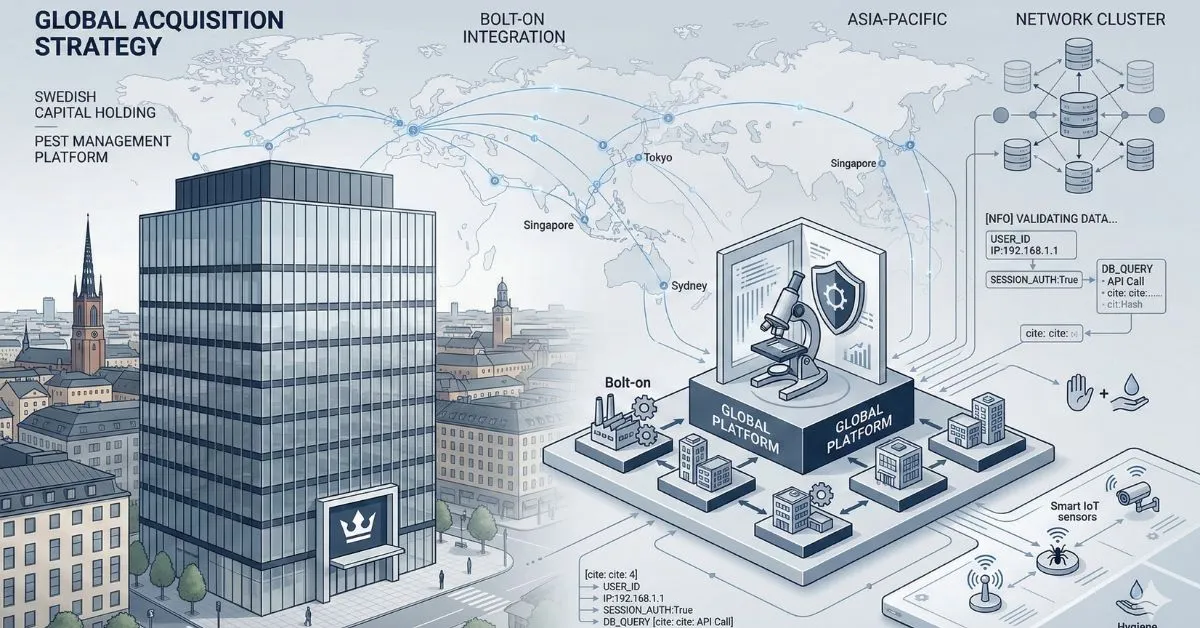
Melker Schörling AB (MSAB) is one of Sweden’s most disciplined long-term investment holding companies. Its strategic relationship with Anticimex — one of the world’s largest pest control and hygiene services companies — exemplifies the Swedish buy-and-build philosophy at its most sophisticated. Through a series of carefully screened bolt-on acquisitions across Europe, North America, Asia-Pacific, and Australia, Anticimex has grown from a domestic Swedish pest control operator into a global platform with operations in more than 20 countries. This article deconstructs the acquisition strategy, ownership dynamics, and competitive logic that underpin that transformation.
- MSAB’s investment philosophy centers on patient capital, active ownership, and businesses with structural recurring revenue.
- Anticimex’s förvärvsstrategi is a disciplined buy-and-build model targeting fragmented pest control markets globally.
- EQT accelerated Anticimex’s international scale during its ownership period; MSAB’s increased stake signals long-term conviction.
- Co-investors GIC, AMF Pension, and Interogo Holding create an ownership consortium aligned around long-duration value creation.
- Decentralized operations and Anticimex SMART are the company’s primary competitive moats.
- Risks include integration complexity, rising acquisition multiples, and leverage exposure — manageable with governance discipline.
- The Swedish corporate governance model is a structurally replicable source of competitive and strategic advantage.
How does a Swedish investment firm quietly build a multi-billion-euro global pest control empire? Not through flashy announcements or aggressive hostile takeovers — but through patience, disciplined capital allocation, and a relentless förvärvsstrategi executed over decades.
Anticimex is rarely the loudest name in a room of private equity giants. Yet while others chase quarterly returns, Melker Schörling AB and its co-investors have systematically assembled one of the world’s most defensible businesses: a recurring-revenue pest control and hygiene services platform that benefits from structural tailwinds including urbanization, food safety regulation, and rising awareness of vector-borne disease.
The story of how MSAB, EQT, GIC, AMF Pension, and Interogo Holding collectively shaped Anticimex into a global leader is a masterclass in long-term ownership philosophy, decentralized operating models, and strategic acquisition screening. Understanding it offers investors and business strategists a replicable framework — the kind that quietly creates enduring enterprise value.
Melker Schörling AB is a Swedish investment holding company founded by Melker Schörling, one of Sweden’s most respected industrialists. The firm operates on a set of convictions that distinguish it sharply from conventional private equity: indefinite holding periods, active ownership without micromanagement, and a preference for businesses with structural recurring revenue.
MSAB’s portfolio has historically included companies such as Hexpol, Hexagon, BRAVIDA, and Securitas — each representing a durable business in a defensible niche. The common thread is not sector focus, but ownership quality: MSAB seeks companies where long-term capital creates more value than short-cycle financial engineering.
This capital allocation strategy is grounded in the belief that compounding works best when undisturbed. By avoiding unnecessary exits and resisting pressure to optimize for near-term EBITDA, MSAB allows portfolio companies to invest in operational excellence, technology, and talent — the foundations of sustainable competitive advantage.
In practice, this philosophy manifests as a strategic shareholder model: MSAB holds meaningful stakes, participates actively at the board level, and provides patient capital that enables management teams to execute multi-year acquisition strategies without sacrificing operational integrity.
Anticimex was founded in Sweden in 1934, originally operating as a domestic pest control company. For decades it served primarily the Scandinavian market, building a reputation for reliability and technical expertise. The transformation from regional operator to global platform began in earnest when private equity capital, combined with strategic ownership from MSAB, unlocked a more aggressive internationalization agenda.
Today, Anticimex operates in more than 20 countries, serving residential, commercial, and industrial clients across Europe, North America, Asia-Pacific, and Australia. The company’s service portfolio spans traditional pest control, food safety hygiene, fire protection, and increasingly, technology-enabled digital monitoring through its proprietary Anticimex SMART platform.
What distinguishes Anticimex in the European pest control market and beyond is its subscription-based, recurring revenue business model. Unlike transactional pest control operators that respond reactively to infestations, Anticimex structures its commercial relationships around prevention contracts — generating predictable, high-retention revenue streams that command premium valuation multiples.
The pest control industry is also structurally fragmented. Across most geographies, thousands of small, family-owned operators serve local markets with limited scale advantages. This fragmentation is precisely what makes Anticimex’s förvärvsstrategi so powerful: there is a virtually inexhaustible pipeline of bolt-on acquisition candidates at reasonable entry multiples.
“Förvärvsstrategi” is the Swedish term for acquisition strategy, and in the context of Anticimex, it refers specifically to a buy-and-build model — one of the most proven value creation frameworks in private equity and long-term investing.
The mechanics are straightforward in theory, though demanding in execution:
Step 1 — Platform Establishment: A scalable, operationally strong company is identified as the central platform. In Anticimex’s case, the existing Swedish business served this function.
Step 2 — Geographic and Segment Expansion: The platform acquires smaller operators in adjacent geographies or service segments, using superior operational systems, procurement leverage, and brand to extract value.
Step 3 — EBITDA Scaling Through Multiple Arbitrage: Smaller businesses are typically acquired at lower EBITDA multiples than the platform itself commands. As acquired businesses integrate and their earnings flow into the consolidated entity, the same earnings base is re-rated at a higher multiple — creating what practitioners call multiple arbitrage.
Step 4 — Operational Leverage: Central functions such as HR, IT, finance, and marketing are consolidated or shared, while local operations retain autonomy. Fixed cost dilution improves margins across the platform.
Step 5 — Repeat: The cycle repeats across new geographies and segments, compounding value with each iteration.
For Anticimex, this model has been applied with particular discipline. The company does not acquire randomly. Target screening involves rigorous evaluation of local market position, customer retention rates, service quality, management depth, and cultural compatibility — factors that determine whether a bolt-on acquisition will strengthen or dilute the platform.
The EQT Era: Scaling Through Private Equity
EQT, the Stockholm-based global investment firm, played a pivotal role in accelerating Anticimex’s international expansion. During EQT’s ownership period, Anticimex undertook a significant number of acquisitions across Europe and began its push into North American and Asia-Pacific markets.
EQT’s involvement brought not only capital but operational infrastructure: professional acquisition teams, post-merger integration playbooks, and access to a global network of operational advisors. This is consistent with EQT’s broader investment approach, which emphasizes active ownership and operational value creation rather than financial leverage alone.
The private equity ownership cycle at Anticimex illustrates an important dynamic: PE ownership, when well-matched to business characteristics, can serve as an accelerant rather than a distortion. For a company executing a buy-and-build strategy, PE capital provides the firepower to compress a 20-year organic expansion into 5–7 years. The trade-off is the eventual exit requirement — which, in Anticimex’s case, led to a significant ownership restructuring.
The EQT ownership structure enabled Anticimex to reach a scale that fundamentally changed its competitive position. A company that once operated primarily in Scandinavia became, under EQT’s stewardship, a credible global operator capable of competing with Rentokil Initial, Rollins, and other multinational pest control conglomerates.
The ownership transition at Anticimex — in which MSAB increased its stake as EQT’s interest evolved — reflects a deliberate strategic choice rather than opportunism. For MSAB, deepening commitment to Anticimex was consistent with its long-term ownership philosophy: when a business demonstrates durable competitive advantages and a credible reinvestment runway, the rational capital allocation decision is to increase exposure rather than diversify it away.
MSAB’s decision to increase its ownership also signals conviction in Anticimex’s capacity to continue compounding. The pest control industry is not cyclically sensitive in the way that industrials or consumer discretionary sectors are. Demand for pest prevention and hygiene services is non-discretionary for most commercial clients, and increasingly so for residential ones as awareness of health risks grows.
By taking a larger stake, MSAB effectively endorses Anticimex’s management team, its acquisition pipeline, and its technology investment thesis. For institutional co-investors evaluating the company, MSAB’s increased ownership functions as a credibility signal — a sophisticated, long-term investor with deep due diligence capabilities reaffirming its commitment.
Anticimex’s ownership structure is notable for the caliber of its institutional co-investors, each bringing distinct strategic value.
GIC, Singapore’s sovereign wealth fund, represents long-duration capital from a state entity with a mandate to invest across economic cycles. GIC’s participation signals Anticimex’s attractiveness to global allocators seeking quality growth businesses in defensive sectors.
AMF Pension, one of Sweden’s major occupational pension funds, brings domestic institutional credibility and long-term capital aligned with MSAB’s patient ownership culture. AMF’s involvement reflects the broader Swedish corporate governance model, in which pension capital and industrial holding companies often collaborate to support sustainable value creation.
Interogo Holding, the investment vehicle associated with the INGKA (IKEA) ecosystem, adds another layer of long-horizon ownership. Interogo’s stake in Anticimex represents a strategic diversification for a family-oriented holding entity that similarly values predictable, compounding businesses.
Together, these co-investors form an ownership consortium structurally oriented toward long-term value creation — unusual in an era dominated by short-cycle capital. The collective ownership model reduces the risk of forced exits, provides financial stability through downturns, and allows management to execute multi-year strategic plans with confidence.
One of the most counterintuitive aspects of Anticimex’s operational model is its commitment to decentralization. In a company growing primarily through acquisitions, the temptation is often to rapidly centralize functions in order to extract cost synergies. Anticimex resists this impulse — and that restraint is a genuine source of competitive advantage.
Pest control is an intensely local business. Customer relationships are built on trust, local technician familiarity, and response speed. When acquisitions disrupt these local dynamics — by imposing foreign management culture, centralizing scheduling, or rebranding aggressively — customer churn follows.
By maintaining decentralized operating units, Anticimex preserves the local identity and customer relationships that made acquired businesses valuable in the first place. Corporate functions provide support, shared services, and operational best practices — but local managers retain meaningful autonomy over their markets.
This model also aids talent retention. Entrepreneurs who built regional businesses and then sold to Anticimex are more likely to remain engaged when they retain operational authority. This reduces post-acquisition knowledge loss and accelerates integration quality.
Anticimex SMART represents the company’s most significant long-term differentiator: a proprietary connected pest monitoring system that uses digital sensors to detect pest activity in real time, enabling proactive intervention before infestations develop.
The strategic logic of Anticimex SMART is multi-layered. Operationally, digital monitoring reduces the frequency of manual inspection visits, lowering labor costs while maintaining service quality. Technician routes can be dynamically optimized based on sensor data, improving workforce productivity.
From a customer value perspective, clients — particularly in food manufacturing, hospitality, and healthcare — benefit from documented, data-driven pest prevention rather than reactive treatment. This is increasingly required by food safety regulators and audit standards, creating regulatory pull for the product.
Once SMART sensors are installed in a customer’s premises, switching costs increase significantly. Physical infrastructure, historical data, and integration with client compliance systems create durable lock-in that a traditional pest control relationship does not generate. And because technology-enabled recurring revenue businesses command higher EBITDA multiples than traditional service operators, SMART’s expansion shifts Anticimex’s revenue mix toward higher-quality, higher-margin annuity streams.
For MSAB and co-investors, SMART represents a compounding optionality layer on top of an already attractive base business — a technology-led wedge that can widen margins and defend market share against both traditional competitors and potential new entrants.
The quality of a buy-and-build strategy is ultimately determined by the quality of acquisition screening. Undisciplined acquisition programs destroy value through overpayment, cultural mismatches, and operational complexity. Anticimex’s approach is distinguished by its systematic evaluation criteria.
Acquisition candidates are assessed against a framework that prioritizes geographic footprint and local market share, customer concentration and churn rates, management quality and willingness to remain post-acquisition, service portfolio fit, and cultural compatibility with Anticimex’s decentralized operating model.
Pricing discipline is equally critical. Entry multiples on bolt-on acquisitions in fragmented pest control markets are typically meaningfully lower than the consolidated platform multiple — this spread is the structural value creation logic of buy-and-build. Overpaying compresses this spread and eliminates the financial rationale for the entire strategy.
MSAB’s oversight role at the board level helps enforce this discipline. As a long-term shareholder without an exit mandate, MSAB is structurally incentivized to oppose acquisitions that prioritize scale over return on invested capital — a meaningful governance check on management’s natural inclination to grow the top line.
The central tension in any buy-and-build strategy is the trade-off between synergy extraction and cultural preservation. Move too aggressively toward centralization, and you damage the local relationships that justified the acquisition. Move too slowly, and you fail to capture the operational leverage that justifies the acquisition multiple.
Anticimex navigates this tension through a phased integration approach. In the first 12–24 months post-acquisition, the priority is stabilization: retaining key personnel, maintaining customer service levels, and integrating financial reporting. Operational integration — shared procurement, technology migration, process standardization — follows in a subsequent phase. Cultural alignment is pursued through shared values and training rather than imposed uniformity.
This sequenced approach reduces integration risk and preserves the acquired business’s intrinsic value while gradually extracting platform-level synergies. It is consistent with the broader Swedish corporate governance model, which tends to prioritize long-term stakeholder value over short-term financial optimization.
No acquisition strategy is without risk, and intellectual honesty requires a balanced assessment of the vulnerabilities in Anticimex’s model.
Integration Risk: Each acquisition introduces execution risk. Cultural clashes, key personnel departures, and customer disruption are real possibilities that compound with deal volume.
Leverage Risk: Buy-and-build strategies are typically funded with debt. If acquisition pace outstrips cash generation, balance sheet stress can emerge — particularly in periods of rising interest rates or earnings compression.
Valuation Risk: As Anticimex’s acquisition strategy becomes more widely known and pest control consolidation advances, entry multiples on remaining candidates may increase, compressing the multiple arbitrage that drives returns.
Regulatory Risk: Food safety regulation and environmental restrictions on pesticide use could alter the service delivery model and impose compliance costs.
Technology Disruption Risk: The broader IoT and data analytics landscape is competitive, and technological advantages in SMART can potentially be replicated.
Concentration Risk: Geographic concentration in certain European markets creates exposure to regional economic or regulatory shocks.
Acknowledging these risks provides investors with the honest framework necessary to size positions appropriately and monitor key risk indicators.
The global pest control market is large, growing, and consolidating. Key players include Rentokil Initial (UK), Rollins (US, parent of Orkin), ServiceMaster (Terminix), and Ecolab — each pursuing varying combinations of organic growth and acquisition.
Anticimex differentiates itself in several important ways. Its European and Asia-Pacific footprint provides geographic diversification less common among primarily North American-focused operators. Its technology investment in SMART creates service differentiation that traditional operators are only beginning to replicate. And its ownership structure — dominated by long-term, strategic shareholders — allows investment horizons that public-company peers, subject to quarterly earnings pressure, cannot easily match.
Rentokil Initial has pursued a more aggressive acquisitions strategy that has resulted in significant leverage and integration challenges. Rollins operates primarily in North America with a franchise-adjacent model. Anticimex’s balance of geographic scope, technology investment, and ownership quality positions it as a distinctive competitor — less exposed to US market dynamics, more aligned with European and Asian growth trends.
The question every sophisticated investor asks of a quality business is: can it compound value indefinitely, or does the strategy have a finite shelf life?
For Anticimex, the case for long-term compounding rests on several structural supports. The pest control industry’s fragmentation will take decades to fully consolidate, sustaining the bolt-on acquisition pipeline. Urbanization, climate change — which expands the range and season of pest populations — and tightening food safety regulation all structurally increase demand for professional pest management. Anticimex SMART’s technology platform creates a continuously improving competitive moat that new entrants would find expensive to replicate.
The primary risk to the compounding thesis is not competitive disruption but strategic drift — the temptation to overpay for acquisitions, expand into adjacent but unfamiliar service categories, or sacrifice the decentralized operating culture in pursuit of near-term margin improvement.
MSAB’s continued presence as a major, engaged shareholder is perhaps the most important structural protection against these risks. Patient, experienced ownership that prioritizes return on invested capital over headline growth is the governance mechanism most likely to keep Anticimex on its optimal compounding trajectory.
The Anticimex case offers transferable lessons for investors, operators, and strategists beyond the pest control sector.
Lesson 1 — Fragmented Markets Are Structural Opportunities. Any sector characterized by thousands of small, subscale operators is a candidate for a buy-and-build platform. The key is identifying which fragmented markets have structural characteristics — recurring demand, limited capital intensity, local brand value — that make consolidation economically rational.
Lesson 2 — Ownership Quality Matters as Much as Business Quality. The same business, owned by patient long-term capital versus short-cycle financial buyers, will follow different strategic trajectories. MSAB’s presence at Anticimex ensures decisions are made on a 10-year time horizon, not a 3-year one.
Lesson 3 — Technology Investment Compounds. Anticimex SMART is not just a product feature — it is a strategic asset that improves with scale and data. Companies that embed technology into fragmented service businesses can shift competitive dynamics across entire industries.
Lesson 4 — Decentralization Is Not a Weakness. In businesses where local relationships drive customer retention, preserving operational autonomy post-acquisition is a genuine competitive advantage.
Lesson 5 — Governance as Value Driver. Sweden’s corporate governance model — characterized by engaged industrial shareholders, transparent board oversight, and long-term orientation — produces outcomes that passive, dispersed ownership structures rarely achieve.
Strengths
- Structural recurring revenue from subscription-based prevention contracts
- Deep bolt-on acquisition pipeline in fragmented global pest control markets
- Anticimex SMART technology moat with growing installed base and proprietary data
- Patient, aligned long-term ownership consortium (MSAB, GIC, AMF, Interogo)
- Decentralized model preserving local customer relationships and entrepreneurial talent
Weaknesses
- High execution risk in high-volume acquisition environments
- Leverage exposure from debt-financed acquisition programs
- Integration complexity increases non-linearly with scale
- Limited public market transparency as a private company
Opportunities
- Urbanization and climate change structurally expanding pest populations and demand
- Tightening food safety and hygiene regulation driving commercial contract growth
- Asia-Pacific market remains significantly underpenetrated
- Cross-sell potential: fire protection and hygiene services to existing pest control accounts
- Data monetization from the SMART sensor network remains largely unrealized
Threats
- Rising acquisition multiples as global industry consolidation advances
- Competitor technology investment narrowing SMART differentiation over time
- Regulatory restrictions on certain pest control chemicals or application methods
- Economic downturns affecting discretionary residential spending segments
- Key management departures post-acquisition reducing operational knowledge retention
| Dimension | Buy-and-Build | Organic Growth |
| Speed to scale | High | Low to moderate |
| Capital requirement | High (acquisition funding) | Moderate (reinvestment) |
| Execution risk | High (integration complexity) | Moderate (market expansion) |
| Multiple arbitrage opportunity | Yes — if discipline maintained | No |
| Cultural risk | High | Low |
| Management complexity | High | Moderate |
| Revenue predictability | Improves with consolidated scale | Market-dependent |
| Best suited for | Fragmented, local-trust markets | High-growth product markets |
| Valuation at exit | Platform premium possible | Market rate |
| Swedish examples | Anticimex, Lifco, Addtech | Organically grown technology firms |
For institutional and private investors evaluating Anticimex or comparable platforms, the strategic framework described in this article has direct portfolio implications.
Businesses with genuine buy-and-build DNA — disciplined acquisition screening, patient ownership, structural recurring revenue, technology investment — deserve premium valuation. They are not simply executing a financial strategy; they are building enduring competitive infrastructure that becomes progressively harder to replicate.
Ownership structure analysis is a critical input to business quality assessment. Anticimex’s consortium of MSAB, GIC, AMF Pension, and Interogo Holding is not incidental — it is the governance foundation that makes the long-term strategy credible and resistant to short-term distortion.
The pest control industry’s structural dynamics — fragmentation, non-discretionary demand, regulatory tailwinds — make it a compelling sector for long-duration capital. Anticimex is the most sophisticated expression of those dynamics, but comparable opportunities exist in adjacent service sectors applying the same förvärvsstrategi logic.
What is Melker Schörling AB’s strategy with Anticimex?
MSAB acts as a long-term strategic shareholder, supporting Anticimex’s global buy-and-build expansion while prioritizing disciplined capital allocation and sustainable compounding over short-term growth.
How does Anticimex’s buy-and-build model work?
Anticimex acquires strong local pest control operators in fragmented markets, integrates them into its platform, improves margins through scale and technology, and creates value through earnings growth and multiple expansion.
Why did MSAB increase its ownership in Anticimex?
MSAB increased its stake due to confidence in Anticimex’s recurring revenue model, acquisition pipeline, and long reinvestment runway as a high-quality compounder.
Is Anticimex still owned by EQT?
EQT previously accelerated Anticimex’s global growth, but ownership has evolved, with MSAB, GIC, AMF Pension, and Interogo Holding now key shareholders.
What are the risks of Anticimex’s aggressive acquisition strategy?
Risks include integration challenges, rising acquisition prices, leverage exposure, cultural dilution, and regulatory changes impacting environmental compliance.
How does decentralization create value in Anticimex’s model?
Decentralization preserves local customer trust and operational expertise while enabling platform-level synergies in procurement, technology, and reporting.
What is Anticimex SMART and why is it strategically important?
Anticimex SMART is an IoT-based pest monitoring system that enables preventive services, increases customer retention, and shifts revenue toward higher-margin recurring streams.
How does Anticimex compare to Rentokil Initial and Rollins?
Anticimex differentiates through stronger tech integration and private long-term ownership, with broader international exposure than Rollins and a more focused strategy than Rentokil Initial.
 Callum