
 By admin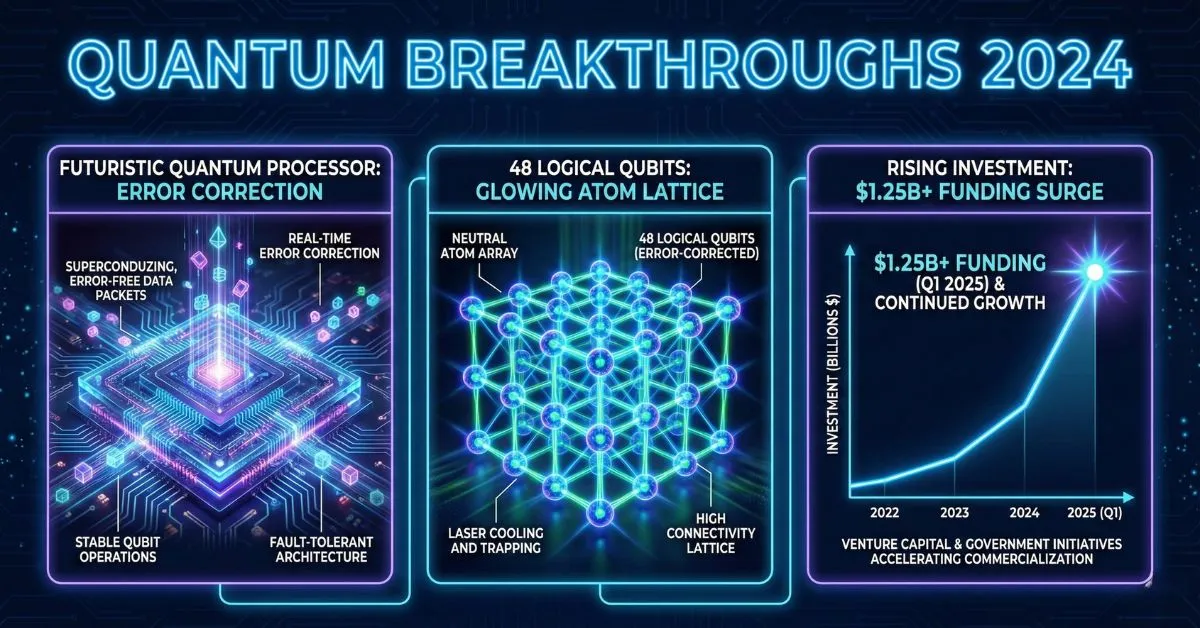
For years, quantum computing felt like a perpetual promise. Lab demonstrations would make headlines, but the technology always seemed to remain just out of reach. Then 2024 happened, and something fundamental shifted. The field moved from answering “can we build quantum computers?” to tackling “how do we scale them reliably?”
December 2024 brought the most striking validation when Physics World named two quantum error correction breakthroughs as co-winners of their prestigious Breakthrough of the Year award. This wasn’t just another research milestone. It represented the culmination of nearly three decades of theoretical work finally manifesting in working hardware. Google Quantum AI demonstrated quantum error correction below the surface code threshold in a superconducting chip, while Harvard University, MIT, and QuEra Computing achieved quantum error correction on an atomic processor with 48 logical qubits.
The real question isn’t whether quantum computing arrived in 2024. It’s whether you’re ready for what comes next.
Before diving into 2024’s breakthroughs, we need to address the fundamental problem that has plagued quantum computing since its inception. Classical computer bits are simple: they’re either 0 or 1. Flip a switch, and you get a reliable answer every time.
Quantum bits, or qubits, operate under entirely different rules. They can exist in superposition, representing both 0 and 1 simultaneously. They can become entangled, where measuring one instantly affects another regardless of distance. They can interfere with each other, amplifying correct answers while canceling errors. These quantum properties enable computations that would take classical computers longer than the age of the universe.
But here’s the catch: qubits are extraordinarily fragile. A stray photon, a tiny vibration, even thermal fluctuations at near absolute zero can cause quantum states to collapse. Researchers call this decoherence, and it happens fast—often within microseconds. Every operation on a qubit introduces errors, and these errors compound rapidly.
For decades, the industry faced a paradoxical problem. Adding more qubits should increase computational power, but it also multiplied error sources. Building larger quantum computers made them less reliable, not more capable. This created a seemingly insurmountable barrier to practical quantum computing.
Google’s Willow processor, announced in December 2024, solved a problem that many physicists doubted was achievable with current technology. The chip demonstrated something called “below threshold” error correction—a technical achievement with profound implications.
The Willow chip achieved exponential suppression of logical error rates as the number of physical qubits increased, with a distance-7 surface code showing just 0.143% error per cycle of error correction. In plain language: the more qubits they added, the fewer errors occurred. This reversed the fundamental trend that had limited quantum computing for three decades.
The team tested increasingly larger arrays of qubits, moving from 3×3 grids to 5×5 to 7×7 configurations. Each expansion halved the error rate. This exponential improvement represents the difference between a laboratory curiosity and a practical computing platform.
Willow also tackled the Random Circuit Sampling benchmark, completing a calculation in under five minutes that would require today’s fastest supercomputers approximately 10 septillion years. Critics rightfully note this specific problem has limited real-world applications. The achievement matters because it proves quantum computers can reliably outperform classical systems when properly error-corrected.
The Google team estimates that achieving error rates low enough for practical applications will require each logical qubit to comprise around 1000 physical qubits, though improvements in error-correction techniques could potentially reduce this to 200 physical qubits. These aren’t theoretical projections anymore—they’re engineering targets with clear pathways.
While Google pursued superconducting qubits, researchers at Harvard University, MIT, and QuEra Computing took a completely different approach using neutral atoms trapped and manipulated by lasers. Their achievement demonstrates that quantum error correction works across multiple hardware platforms, not just one specific technology.
The team created 48 logical qubits using reconfigurable atom arrays. What makes this remarkable is the architectural flexibility. Unlike superconducting circuits that are lithographically printed and cannot be reconfigured after fabrication, neutral atom systems can rearrange their qubit topology dynamically. This adaptability could prove crucial for running different types of quantum algorithms efficiently.
The diversity of successful approaches matters tremendously. It means the principles of quantum error correction are universal, not dependent on one particular technology. This validation gives the entire field confidence that scaling quantum computers is an engineering challenge, not a physics impossibility.
IBM took a characteristically methodical approach in 2024, laying out what they call a “rigorous end-to-end framework” for fault-tolerant quantum computing. Their updated roadmap extends to 2033 with specific processors at each milestone, including the Starling processor planned for 2028 and the Blue Jay system targeting 2033 with 2,000 qubits capable of running 1 billion gates.
These aren’t vague aspirations. IBM has been transparent about its quantum roadmap since 2020, and they’ve successfully delivered on each milestone so far. Their Heron processor in 2024 could accurately run quantum circuits with up to 5,000 two-qubit gate operations—nearly double their 2023 demonstration. More impressively, experiments that took 112 hours in 2023 now complete in 2.2 hours, representing a 50-fold speedup.
IBM also released Qiskit 1.0, the first stable version of their quantum software development platform serving over 600,000 developers worldwide. Moving to semantic versioning with longer support cycles provides the stability developers need to build complex applications without constant breaking changes.
The company’s transition to quantum low-density parity check (qLDPC) codes represents a significant strategic shift. Their “gross code” architecture uses a biplanar chip with 144 physical qubits on each surface, yielding 12 logical qubits with distance-12 error correction. This approach leverages classical error correction techniques developed in the 1960s that have proven highly efficient in communications.
Microsoft pursued quantum error correction through a partnership with Quantinuum, focusing on what they call “qubit virtualization.” Their approach creates logical qubits from groups of physical qubits working together, similar to how data storage uses redundancy for reliability.
In April 2024, the collaboration achieved an 800-fold reduction in quantum error rates. By November, they pushed further, creating and entangling 24 logical qubits—a record at the time. More importantly, they demonstrated that quantum systems could maintain coherence across such a large network of logical units.
This work matters because every useful quantum algorithm eventually requires error-corrected qubits to produce reliable results. Microsoft and Quantinuum showed a clear pathway from current noisy systems to fault-tolerant quantum computers, with working demonstrations rather than just theoretical models.
One of 2024’s most intriguing developments came from Google DeepMind with their AlphaQubit system. This recurrent, transformer-based neural network learns to decode quantum error correction codes, outperforming state-of-the-art decoders on real data from Google’s Sycamore quantum processor for both distance-3 and distance-5 surface codes.
The convergence of artificial intelligence and quantum computing created a virtuous cycle. AI helps build better quantum computers through improved error correction. Quantum computers promise to accelerate certain types of machine learning. This synergy attracted significant attention from researchers exploring quantum-enhanced machine learning, faster neural network optimization, and improved data sampling methods.
Quantinuum implemented QDisCoCirc, a scalable Quantum Natural Language Processing model addressing text-based tasks like question answering. The approach demonstrated advantages over classical models, particularly in generalizing across different tasks. While we’re still in the early stages, 2024 proved that quantum-AI integration isn’t science fiction—it’s an active research frontier producing measurable results.
The pharmaceutical industry moved decisively beyond exploratory partnerships in 2024. AstraZeneca collaborated with Amazon Web Services, IonQ, and NVIDIA to demonstrate a quantum-accelerated computational chemistry workflow for chemical reactions used in small-molecule drug synthesis. Merck KGaA and Amgen partnered with QuEra to leverage quantum computing for predicting biological activity of drug candidates.
The application makes intuitive sense. Molecules are quantum mechanical systems. Classical computers simulate molecular behavior by approximating quantum mechanics, but these approximations break down for complex molecules. Quantum computers can simulate quantum systems naturally, potentially providing more accurate predictions of molecular properties, binding affinities, and reaction mechanisms.
Researchers from Pasqal, Qubit Pharmaceuticals, and Sorbonne Université developed a quantum-enhanced method using neutral atom quantum processing units to predict solvent configurations in protein cavities. Their approach achieved high accuracy on real-world protein models, closely aligning with experimental data while outperforming classical methods.
One study published in July 2024 described a hybrid quantum computing pipeline tailored for real drug discovery problems, tackling Gibbs free energy profiles for prodrug activation and simulating covalent bond interactions. These represent genuine challenges drug designers face daily, not simplified academic problems.
The economic implications are staggering. The pharmaceutical industry spends over $2 billion on average to bring a new drug to market, over a timeline exceeding a decade. Even modest improvements in early-stage computational predictions could save billions of dollars and accelerate new therapies to patients. McKinsey estimated the quantum ecosystem could deliver nearly $200 billion in economic impact to pharmaceuticals and medical products by 2035.
The financial sector approached quantum computing with a dual mindset in 2024: opportunity and threat. On the opportunity side, quantum algorithms promise to optimize massive portfolios, model complex risk scenarios, and detect subtle patterns in market data that classical systems miss.
Quantum Motion and Goldman Sachs collaborated on research demonstrating how quantum computing could transform financial services calculations like options pricing, introducing methods for breaking complex quantum algorithms into parallel smaller tasks that significantly reduce runtime.
Financial institutions explored quantum applications in Monte Carlo simulations for risk assessment, portfolio optimization using quantum annealing, and fraud detection using quantum machine learning. The technology particularly appeals to high-frequency trading, where microseconds matter and quantum speedups could provide competitive advantages worth billions.
But quantum computing also poses an existential threat to financial security. Current encryption systems protecting trillions of dollars in transactions rely on mathematical problems that quantum computers could eventually solve. This “harvest now, decrypt later” attack vector has security experts extremely concerned.
In August 2024, the National Institute of Standards and Technology finalized three post-quantum cryptography standards designed to withstand quantum computer attacks. The new standards—ML-KEM, ML-DSA, and SLH-DSA—are ready for immediate implementation. The timing matters because adversaries could record encrypted communications today and decrypt them once quantum computers become available.
Industry experts estimate transitioning government and enterprise networks to quantum-resistant encryption could require a decade or more due to legacy infrastructure complexity. Financial institutions began inventorying cryptographic systems, assessing vulnerabilities, and planning migration strategies. The White House initiated quantum policy acceleration, preparing executive actions for federal adoption of post-quantum cryptography.
Financial commitment to quantum computing reached unprecedented levels in 2024. The first three quarters alone saw $1.25 billion in quantum computing investments, more than doubling the previous year. JPMorgan Chase announced a $10 billion investment initiative specifically naming quantum computing as a strategic technology.
Government investments totaled $3.1 billion in 2024, primarily focused on national security and economic competitiveness. Singapore invested approximately $222 million in quantum technology research and talent development. Japan announced a $7.4 billion commitment, while Spain pledged $900 million. China and the United States led in patent applications, with China dominating quantum computing patents while the U.S. focused on quantum communication.
This capital enabled infrastructure expansion. IBM inaugurated its first European quantum data center in Ehningen, Germany in October 2024, allowing European clients to access utility-scale quantum computing without data crossing continental boundaries. Cloud-based quantum computing platforms from Amazon, Google, IBM, and Microsoft democratized access, enabling businesses and researchers to experiment without building their own hardware.
Patent activity surged with a 13% increase in granted quantum technology patents in 2024, led by IBM with 191 patents and Google with 168. This intellectual property buildup signals long-term corporate commitment extending well beyond current market hype.
Despite technological breakthroughs, quantum computing faces a severe human capital shortage. Only an estimated 600-700 quantum error correction specialists exist worldwide, yet 5,000-16,000 are needed by 2030, and training can take up to 10 years.
The field requires expertise spanning quantum mechanics, computer science, mathematics, and often domain knowledge in applications like chemistry or finance. Universities are expanding quantum education programs, but the pipeline problem is acute. Cloud platforms help by allowing more experimentation without deep expertise, but building sophisticated applications still requires specialized knowledge.
This talent scarcity will likely concentrate the best minds in the most promising and well-resourced environments, creating clusters of quantum expertise at leading technology companies and research institutions. The competition for quantum talent resembles the early days of AI and machine learning, where acquiring top researchers became a strategic imperative.
One of 2024’s underappreciated trends was progress across multiple quantum hardware platforms. Superconducting qubits dominated headlines with Google and IBM announcements, but trapped ions, neutral atoms, photonic systems, and topological qubits all advanced.
This diversity matters tremendously. Different quantum hardware platforms have varying strengths and weaknesses. Superconducting qubits excel at fast gate operations but require extreme cooling. Trapped ions offer long coherence times but slower operations. Neutral atoms provide geometric flexibility. Photonic systems could enable room-temperature operation.
Different applications might ultimately work best on different platforms. A drug discovery simulation might run optimally on one type of quantum processor while a financial optimization problem uses another. The field’s diversity provides multiple pathways to quantum advantage rather than betting everything on a single technology.
Rather than waiting for pure quantum computers to solve entire problems, 2024 saw growing adoption of hybrid quantum-classical architectures. These systems divide complex calculations between quantum and classical processors, with each handling the parts of algorithms it’s best suited for.
IBM, RIKEN in Japan, and Cleveland Clinic explored this approach with encouraging results. The quantum processor tackles specific subroutines requiring quantum advantage—like sampling from complex probability distributions or solving certain optimization problems. Classical computers handle data preprocessing, error mitigation, result interpretation, and the majority of computational workflow.
This pragmatic approach acknowledges current limitations while leveraging available quantum resources effectively. It also provides a realistic deployment model for businesses. Organizations don’t need to replace their entire computing infrastructure—they can augment it with quantum accelerators for specific workloads.
Despite genuine progress in 2024, quantum computing faces significant remaining obstacles. Building stable quantum processors requires sophisticated equipment operating at temperatures near absolute zero—colder than outer space. Scaling from hundreds of qubits to millions while maintaining low error rates presents enormous engineering challenges.
Most quantum algorithms promising exponential speedups require fault-tolerant quantum computers that don’t exist yet. Current systems operate in the Noisy Intermediate-Scale Quantum (NISQ) era, where errors limit program complexity. Bridging this gap remains a major research challenge.
Some applications initially thought promising for quantum computing might work better with improved classical algorithms. Researchers periodically discover classical techniques solving problems previously assumed to require quantum computers. This competition drives progress in both quantum and classical computing, but it means quantum advantage won’t appear everywhere people initially expected.
Integration challenges abound. Many financial systems, pricing mechanisms, and risk management tools are designed around classical computational structures that don’t easily incorporate quantum methods. Regulatory requirements in highly regulated industries like banking and insurance add further complexity to deploying quantum technologies.
The quantum computing field has learned to be cautious about predictions after years of overpromising. But 2024’s advances came with credible timelines backed by concrete engineering milestones. IBM projects their Nighthawk processor will demonstrate quantum advantage for specific problems by late 2025. PsiQuantum aims to deliver their first commercial million-qubit system by 2030.
These projections span a range because different applications require different levels of quantum power. Some optimization problems might show quantum advantage with a few hundred logical qubits. Simulating complex chemical reactions might need thousands. Breaking modern encryption would require millions of high-quality qubits running sophisticated algorithms.
For businesses, the strategic implication is clear: quantum computing is transitioning from research curiosity to competitive technology. Companies exploring quantum applications now will understand how to leverage the technology when quantum advantage becomes routine rather than revolutionary. The window for early exploration is open, and entry barriers are lower than ever thanks to cloud platforms and improving development tools.
Organizations should begin quantum readiness assessments across four dimensions: talent development, infrastructure preparation, ecosystem partnerships, and investment horizons. This doesn’t mean rushing to deploy quantum computers that aren’t ready. It means building literacy, experimenting with algorithms, identifying promising use cases, and preparing for post-quantum cryptography migration.
The quantum computing industry reached an inflection point in 2024. Multiple research groups demonstrated solutions to fundamental problems like error correction. Hardware capabilities improved measurably across key metrics. Major companies committed billions in investment. Real applications began emerging in drug discovery, materials science, and computational chemistry.
The field hasn’t solved every challenge or delivered on every promise. Fully fault-tolerant quantum computers capable of breaking modern encryption or revolutionizing artificial intelligence remain years away. But 2024 provided clear evidence that quantum computing has moved beyond perpetual “ten years in the future” status.
The progress suggests the 2020s might ultimately be remembered as the decade when quantum computing transitioned from laboratory demonstrations to practical applications. The combination of breakthrough error correction, diverse hardware approaches, substantial investments, and emerging applications points toward sustained progress rather than another hype cycle.
Not everything will happen as quickly as optimists hope. Some applications will take longer to materialize than vendors promise. But the trajectory is clear. Quantum computing isn’t just coming—it’s already here in early but increasingly useful forms, ready to tackle problems that have eluded classical computers for decades.
What made 2024 different from previous years in quantum computing?
Multiple teams proved practical quantum error correction with peer-reviewed, reproducible results, shifting progress from hype to engineering reality.
How does quantum error correction actually work?
It spreads one unit of quantum information across multiple qubits so errors can be detected and corrected without destroying the data.
When will quantum computers be available for practical business use?
Limited cloud access exists today, but broadly useful, error-corrected systems are expected in 5–10 years, depending on the application.
Can quantum computers break current encryption yet?
No. Current systems are far too small, but future risk prompted post-quantum encryption standards released in 2024.
What industries will see quantum computing impact first?
Pharmaceuticals, materials science, and finance, where quantum methods match high-value, complex problems.
How much are companies investing in quantum computing?
Over $1.25 billion was invested in 2024, with governments and major tech firms committing billions more.
What skills are needed to work in quantum computing?
Strong foundations in physics, math, and computer science, plus domain expertise, with severe global talent shortages.
How does quantum computing help with drug discovery?
It models molecular behavior more accurately than classical computers, improving drug simulation and candidate screening.
What is the difference between quantum advantage and quantum supremacy?
Supremacy proves quantum can beat classical systems on any task, while advantage focuses on useful, real-world problems.
Should organizations start preparing for quantum computing now?
Yes. They should build literacy, experiment via cloud platforms, and begin transitioning to post-quantum cryptography.