
 By admin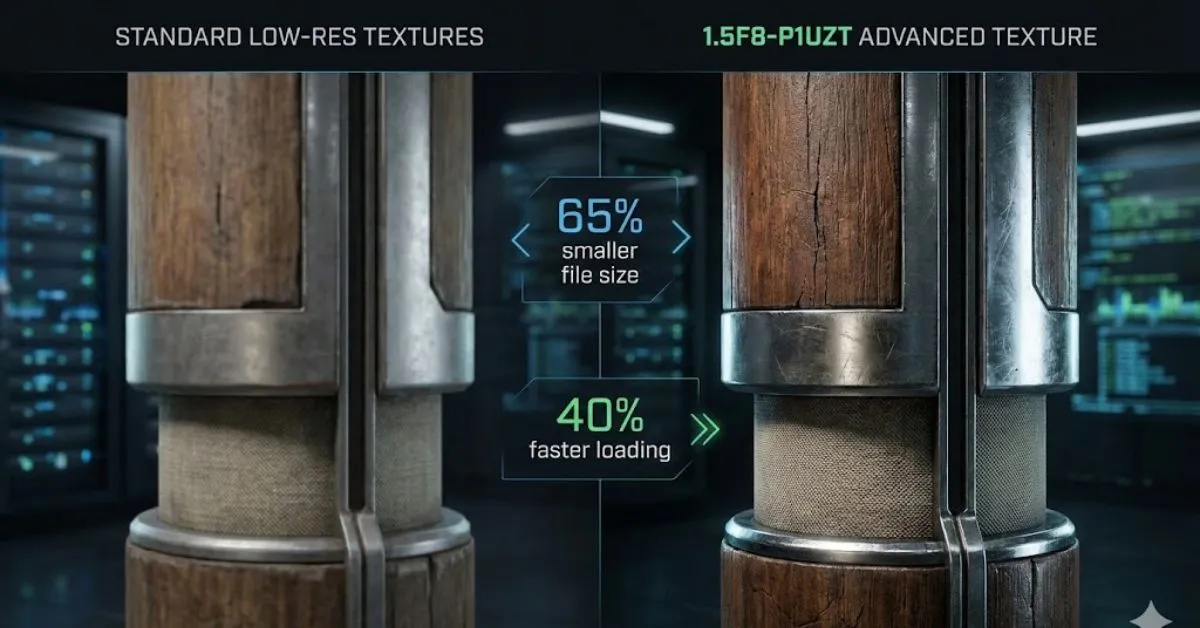
Quick Answer: The 1.5f8-p1uzt texture is an advanced digital surface mapping format that combines 8-bit floating-point precision with smart compression algorithms. It reduces file sizes by up to 65% while maintaining visual quality, making it ideal for game development, VR applications, and 3D rendering. The format supports resolutions from 512×512 to 4096×4096 pixels and works seamlessly across Unity, Unreal Engine, and Blender.
Modern digital graphics demand both stunning visual quality and efficient performance. The 1.5f8-p1uzt texture format delivers exactly this balance. This revolutionary texture standard has changed how developers and designers create realistic 3D environments.
Whether you work in game development, virtual reality, architectural visualization, or digital art, understanding the 1.5f8-p1uzt texture can dramatically improve your workflow. This format solves the age-old problem of choosing between quality and performance.
In this comprehensive guide, you’ll discover what makes this texture format special, how to use it effectively, and why it’s becoming the industry standard for modern 3D graphics.
The 1.5f8-p1uzt texture is a specialized digital surface mapping format designed for modern 3D applications. The name itself contains important technical information about the format.
Breaking down the name:
- 1.5 – Version number indicating the format revision
- f8 – 8-bit floating-point precision for each color channel
- p1uzt – Unique identifier for this specific texture profile
Unlike traditional flat textures, the 1.5f8-p1uzt format uses Physically Based Rendering (PBR) technology. This means it includes multiple data layers that tell the computer exactly how light should interact with surfaces.
The format includes roughness maps, metallic levels, and normal data. These components work together to create surfaces that look and feel realistic under different lighting conditions.
The 1.5f8-p1uzt texture achieves its impressive balance of quality and performance through smart data management. Instead of storing every detail, it focuses on information that matters most to the human eye.
The texture uses separate layers for color, depth, and surface detail. These layers load only when needed, which speeds up rendering significantly. When you’re far from an object, the system loads less detail. Move closer, and more detail appears automatically.
The 1.5f8-p1uzt format uses advanced compression that removes unnecessary data without affecting visual quality. This compression is GPU-friendly, meaning graphics cards can process it quickly without extra work.
The format supports adaptive resolution scaling. On powerful systems, it displays full 4096×4096 pixel detail. On weaker devices, it automatically reduces detail to maintain smooth performance.
The 1.5f8-p1uzt texture format offers significant advantages over traditional texture formats. These benefits make it increasingly popular across multiple industries.
This format reduces memory usage by up to 65% compared to standard textures. Smaller files mean faster downloads, quicker loading times, and less storage space needed. For mobile games and web applications, this reduction is critical.
Load times improve by approximately 40% thanks to optimized streaming algorithms. The texture format processes multiple channels simultaneously, making better use of modern graphics cards. This results in smoother frame rates and better overall performance.
The 1.5f8-p1uzt texture works seamlessly across different platforms. Whether you’re targeting PC, console, mobile, or web, the same texture file adapts to each platform’s requirements. This saves development time and prevents version conflicts.
Despite smaller file sizes, the format maintains excellent visual quality. The 8-bit floating-point precision provides smooth color gradients and realistic lighting behavior. Most viewers cannot distinguish between this format and much larger alternatives.
The 1.5f8-p1uzt texture format finds use across numerous industries and applications. Its versatility makes it suitable for many different purposes.
Game developers use 1.5f8-p1uzt textures extensively for character models, environments, and props. The format allows detailed worlds without sacrificing performance. Players experience rich visual detail while games maintain smooth frame rates across different devices.
VR and AR applications require lightweight textures that still deliver realism. The 1.5f8-p1uzt format excels here, providing immersive visuals without draining device batteries or causing motion sickness through performance drops.
Architects use this texture format to create photorealistic renderings of buildings, interiors, and materials. Clients can see accurate representations of wood, stone, metal, and fabric finishes before construction begins.
CGI artists in film production benefit from the format’s high bit-depth color accuracy. The texture supports adaptive tessellation, preserving minute details essential for cinematic quality work.
Product designers create virtual prototypes using 1.5f8-p1uzt textures. The precise displacement mapping feature translates well to 3D printing and CAD modeling, helping designers experiment with surface finishes before physical production.
Implementing 1.5f8-p1uzt textures requires understanding your specific needs and platform requirements. This guide helps you make informed decisions.
Check whether your target devices support 8-bit floating-point textures. Modern GPUs handle this format easily, but older hardware from before 2018 may have limitations. Consider your minimum specification targets carefully.
The format supports resolutions from 512×512 to 4096×4096 pixels. For mobile applications, 1024×1024 often provides the best balance. Desktop and console games can use 2048×2048 or higher for hero assets and important surfaces.
Ensure your development environment supports the format. Unity, Unreal Engine, and Blender all work well with 1.5f8-p1uzt textures. You may need specific plugins like NVIDIA Texture Tools Exporter for design software such as Photoshop.
Establish clear naming conventions and version control for your texture files. Using consistent formats like ‘albedo_1.5f8-p1uzt.png’ helps teams avoid confusion and ensures everyone uses the correct assets.
Integrating 1.5f8-p1uzt textures into your workflow is straightforward. Follow these steps for successful implementation.
Bring the texture file into your software just like any other texture. Most tools recognize the format automatically and apply appropriate settings.
Assign the texture to your 3D models, walls, characters, or objects. Adjust the scale and orientation to ensure proper alignment with your geometry.
Match your engine’s sampling rules to the texture’s floating-point format. Disable auto-compression in import settings that might reduce visual fidelity. Enable mipmaps for better performance at different viewing distances.
Preview the texture in your target environment early. Check how it appears under different lighting conditions and at various distances. Monitor performance metrics to ensure smooth operation.
Like any technology, the 1.5f8-p1uzt texture format has both advantages and limitations. Understanding these helps you make informed decisions.
- Significantly reduced file sizes save storage and bandwidth
- Faster load times improve user experience
- Excellent visual quality despite compression
- Cross-platform compatibility reduces development time
- Efficient GPU utilization maximizes hardware performance
- Dynamic resolution scaling adapts to different devices
- Supports real-time texture updates with minimal performance impact
- Limited compatibility with legacy hardware before 2018
- High-resolution textures require powerful GPUs for smooth rendering
- Increased VRAM usage for advanced features needs optimization
- Some rendering engines need plugins or updates for full support
- Learning curve exists for teams unfamiliar with PBR workflows
Following best practices ensures you get maximum benefit from 1.5f8-p1uzt textures throughout your project lifecycle.
Use lowercase letters and hyphens in filenames to avoid case-sensitive path issues across different operating systems. Include version numbers in names to track updates easily.
Create a README file explaining your texture format decisions. Note that 1.5 refers to version 1.5 with floating-point precision. This documentation prevents confusion during team handoffs.
Always preview textures in your target environment before final integration. Check appearances in different lighting scenarios, at various distances, and on minimum specification hardware.
Adjust resolution and compression settings based on platform requirements. Mobile devices benefit from more aggressive optimization, while high-end PCs can handle maximum quality settings.
Store textures in clearly labeled folders separated by type, resolution, and usage. This organization speeds up asset location and prevents accidental use of wrong versions.
The 1.5f8-p1uzt texture format continues evolving alongside advances in graphics technology. Several exciting developments are on the horizon.
AI-enhanced texture mapping will use machine learning to automate and optimize texture creation. These systems will analyze real-world images and generate textures that appear convincingly organic without manual intervention.
Real-time ray tracing support is improving, with better compatibility between the format and ray tracing technologies. This integration will enable ultra-realistic lighting and reflections while maintaining the format’s efficiency advantages.
Procedural generation integration will allow infinite texture variations from a single base file. This removes repetitive patterns common in older texture formats and enables more natural-looking environments.
The 1.5f8-p1uzt texture format represents a significant advancement in digital graphics technology. By combining high visual quality with efficient performance, it solves problems that have challenged developers for years.
Whether you create games, design architectural visualizations, or produce digital art, this format offers tangible benefits. Smaller file sizes reduce storage costs and improve load times. Cross-platform compatibility streamlines development workflows. Maintained visual quality ensures your projects look professional.
As graphics technology continues advancing, formats like 1.5f8-p1uzt will become increasingly important. The combination of AI-driven optimization, ray tracing support, and procedural generation positions this format at the forefront of modern 3D graphics.
Start experimenting with 1.5f8-p1uzt textures in your next project. The learning curve is minimal, but the performance and quality improvements are substantial. Your users will notice smoother experiences, and your development team will appreciate more efficient workflows.
What does the ‘f8’ in 1.5f8-p1uzt mean?
The ‘f8’ indicates 8-bit floating-point precision per color channel. This provides an excellent balance between visual fidelity and performance. The floating-point format allows smooth color gradients and realistic lighting behavior without the memory overhead of 16-bit or 32-bit alternatives.
Can I use 1.5f8-p1uzt textures on mobile devices?
Yes, but with considerations. Modern mobile devices from 2018 onward generally support the format well. For best mobile performance, use lower resolutions like 1024×1024 and enable aggressive compression. Always test on your minimum specification target device to ensure acceptable frame rates.
How much smaller are 1.5f8-p1uzt texture files compared to standard formats?
The format typically reduces file sizes by 40-65% compared to uncompressed or standard compressed textures. A texture that would normally require 100MB might only need 35-60MB in 1.5f8-p1uzt format. The exact savings depend on texture complexity and content type.
Which game engines support 1.5f8-p1uzt texture format?
Unity, Unreal Engine, Blender, and most modern 3D tools support this texture format. Some engines may require enabling specific import settings or installing plugins like NVIDIA Texture Tools Exporter. WebGL applications can also use the format through appropriate loaders.
Do I need special skills to work with 1.5f8-p1uzt textures?
Basic 3D graphics knowledge is helpful, but the format itself is straightforward to use. If you understand how to apply standard textures in your chosen software, you can work with 1.5f8-p1uzt textures. The main learning curve involves understanding PBR workflows and optimizing settings for different platforms.
 Callum